PACG SOVEREIGN INFRASTRUCTURE ARCHITECTURE SYSTEM | RELEASE: v1.0.0 | NODES ONLINE: 12 / 12
LAYERS: 6 ACTIVE | DOC: PACG/ARCH/2026/001
PAN-AFRICAN COMMODITIES GATEWAY · SOVEREIGN INFRASTRUCTURE ARCHITECTURE · 2026

SOVEREIGN TRADE
INFRASTRUCTURE

Africa's continental commodity trade infrastructure — six sovereign layers, 12 primary nodes, 54 member states. Designed at the scale of SWIFT, the intelligence of Palantir, the authority of a central bank.

6
SOVEREIGN LAYERS
54
MEMBER STATES
12
PRIMARY NODES
T+0
SETTLEMENT TIME
$847B
DAILY FLOW CAPACITY
99.99%
UPTIME SLA
SECTION 01 — SIX-LAYER SOVEREIGN INFRASTRUCTURE STACK

The PACG System Architecture

Six tightly coupled sovereign infrastructure layers — from physical commodity trust at the foundation to AI-powered command authority at the apex. Each layer is independently scalable and governed under AfCFTA and AU frameworks.
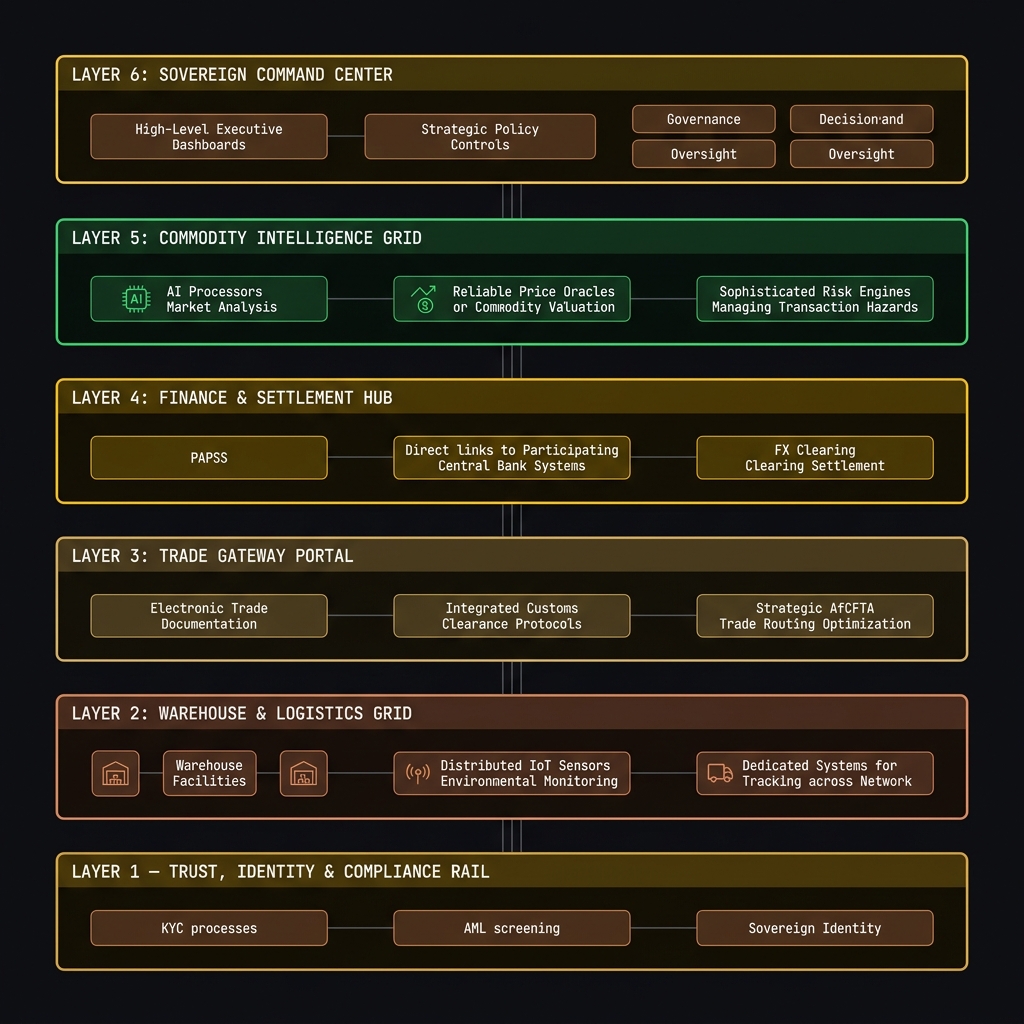
PACG six-layer sovereign infrastructure stack — complete architecture diagram
PACG SIX-LAYER SOVEREIGN INFRASTRUCTURE STACK ARCHITECTURE DIAGRAM · REF: PACG-ARCH-001
INTERACTIVE LAYER EXPLORER

Click any layer to expand specifications

L6 SOVEREIGN COMMAND CENTER
EXECUTIVE COMMAND CONSOLE
Presidential and ministerial-level real-time oversight. Access to all 54 node feeds simultaneously.
POLICY ENGINE
Sovereign council policy controls. Real-time tariff, quota, and trade corridor configuration.
SOVEREIGN AUDIT SYSTEM
Immutable audit trail across all 6 layers. AU Commission direct reporting feed.
GEOPOLITICAL ALERT CENTER
Trade disruption early warning, sanctions screening, force majeure detection.
L5 COMMODITY INTELLIGENCE GRID
AI PRICE ORACLE
Real-time price discovery engine. Cross-references LME, CBOT, ICE with continent-native price feeds from 12 exchange nodes.
RISK SCORING ENGINE
ML-based counterparty risk assessment. Fraud detection across 847 commodity types and 54 jurisdictions in real time.
CORRIDOR OPTIMIZER
AI-powered logistics route optimization. Dynamic routing across 23 active trade corridors considering cost, risk, and speed.
DEMAND FORECASTING AI
72-hour and 30-day commodity demand forecasting models trained on 10 years of continental trade data.
L4 FINANCE & SETTLEMENT HUB
PACG CLEARING HOUSE
Central multilateral clearing hub. Processes up to 2.4M settlement instructions per day across 54 currencies.
PAPSS GATEWAY
Pan-African Payment and Settlement System integration. Real-time cross-border payment confirmation in local currencies.
FX SETTLEMENT ENGINE
CLS-style multilateral netting engine. 54 central bank bridges with T+0 final settlement finality.
TRADE FINANCE BRIDGE
Letters of credit automation, Afreximbank facility integration, African Development Bank guarantee layer.
L3 TRADE GATEWAY PORTAL
ELECTRONIC TRADE DOCS
Fully digital BoL, certificates of origin, phytosanitary certificates. AfCFTA-compliant e-document standard.
CUSTOMS CLEARANCE ENGINE
Automated customs processing across 54 authorities. Pre-clearance and fast-lane certification for verified participants.
AFCFTA ROUTING
Intelligent trade corridor assignment. Preferential tariff calculation and duty optimization under AfCFTA schedules.
PARTICIPANT PORTAL
Institutional participant interface. Role-based access: broker, warehouse, central bank, regulator, sovereign oversight.
L2 WAREHOUSE & LOGISTICS GRID
CERTIFIED WAREHOUSE NETWORK
847 PACG-certified warehouses across 54 nations. Real-time inventory, grade, and location visibility.
IoT SENSOR GRID
Temperature, humidity, weight, and GPS sensors on all certified storage facilities. Tamper-evident sealing protocols.
CARGO TRACKING SYSTEM
End-to-end shipment monitoring. AIS vessel integration, road transport GPS, rail manifest APIs.
WAREHOUSE RECEIPT REGISTRY
National DWR registries federated into a continental master registry. Blockchain-anchored immutability.
L1 TRUST, IDENTITY & COMPLIANCE RAIL
SOVEREIGN IDENTITY SYSTEM
Continental participant identity ledger. Legal entity identifier (LEI) integration. 54-nation KYC federation.
AML/CFT SCREENING ENGINE
FATF-compliant real-time AML screening. OFAC, UN, AU sanctions list integration. Automated SAR filing.
REGULATORY COMPLIANCE RAIL
Jurisdictional compliance rules engine for 54 regulatory regimes. Automated licensing verification and status monitoring.
CRYPTOGRAPHIC TRUST LAYER
PKI certificate authority for all PACG participants. Message signing, non-repudiation, audit trail anchoring.
FOUNDATION FRAMEWORK
AfCFTA TREATY AU CONSTITUTIVE ACT PAPSS AGREEMENT BIS CPMI-IOSCO PRINCIPLES FATF RECOMMENDATIONS ISO 20022 FIX PROTOCOL 4.4 AFREXIMBANK CHARTER
SECTION 02 — CONTINENTAL NODE NETWORK

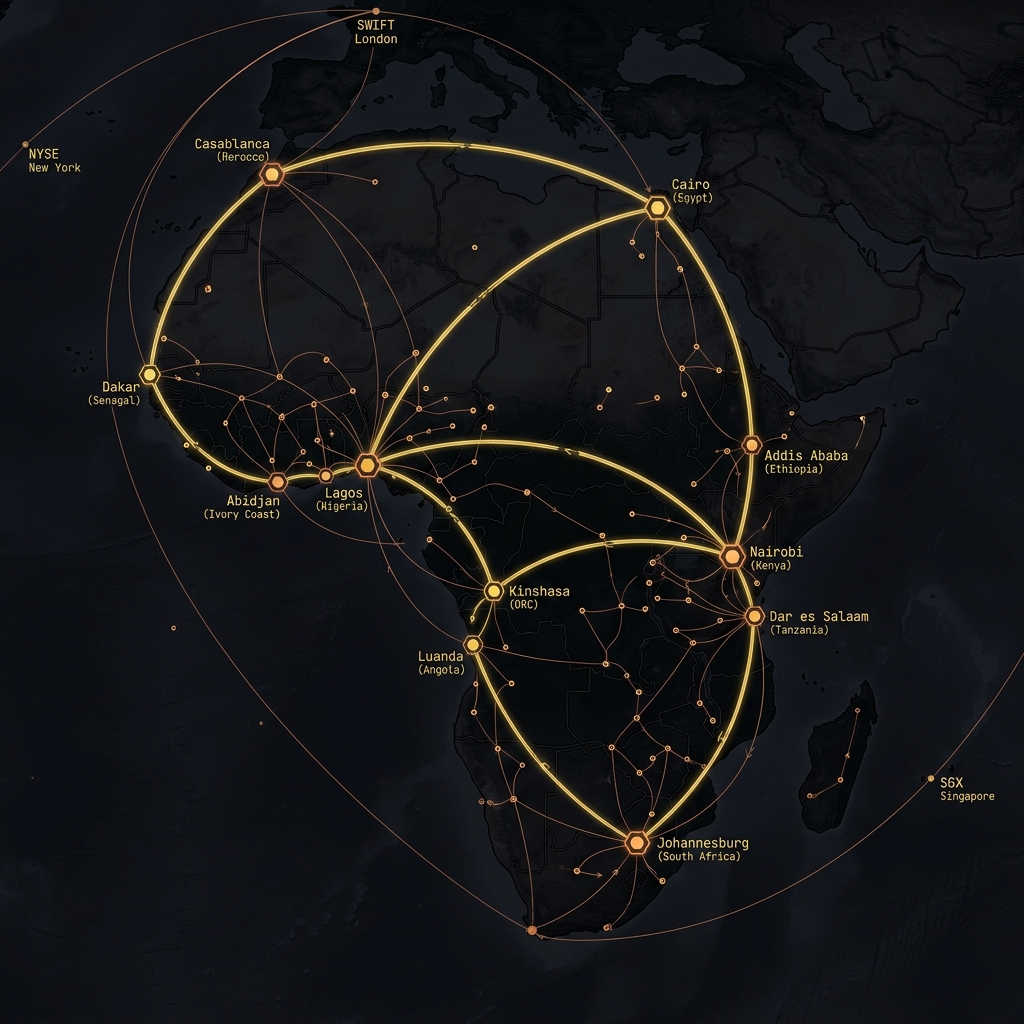
12-Node Sovereign Gateway System

Twelve primary sovereign nodes form the continental backbone — positioned across Africa's six geographic regions, each node a fully sovereign infrastructure installation operating under national law and PACG protocol.

PACG continental node network — 12 sovereign gateway nodes across Africa with global connections
PACG CONTINENTAL NODE NETWORK — 12 PRIMARY SOVEREIGN NODES LIVE STATUS: ALL NODES OPERATIONAL · LAST SYNC: 00:00:01 UTC
NG
LAGOS
Nigeria
TIER 1 PRIMARY
ZA
JOHANNESBURG
South Africa
TIER 1 PRIMARY
EG
CAIRO
Egypt
TIER 1 PRIMARY
KE
NAIROBI
Kenya
TIER 1 PRIMARY
MA
CASABLANCA
Morocco
TIER 2 REGIONAL
CI
ABIDJAN
Côte d'Ivoire
TIER 2 REGIONAL
TZ
DAR ES SALAAM
Tanzania
TIER 2 REGIONAL
GH
ACCRA
Ghana
TIER 2 REGIONAL
SN
DAKAR
Senegal
TIER 2 REGIONAL
ET
ADDIS ABABA
Ethiopia
TIER 2 REGIONAL
CD
KINSHASA
DR Congo
TIER 2 REGIONAL
AO
LUANDA
Angola
TIER 2 REGIONAL
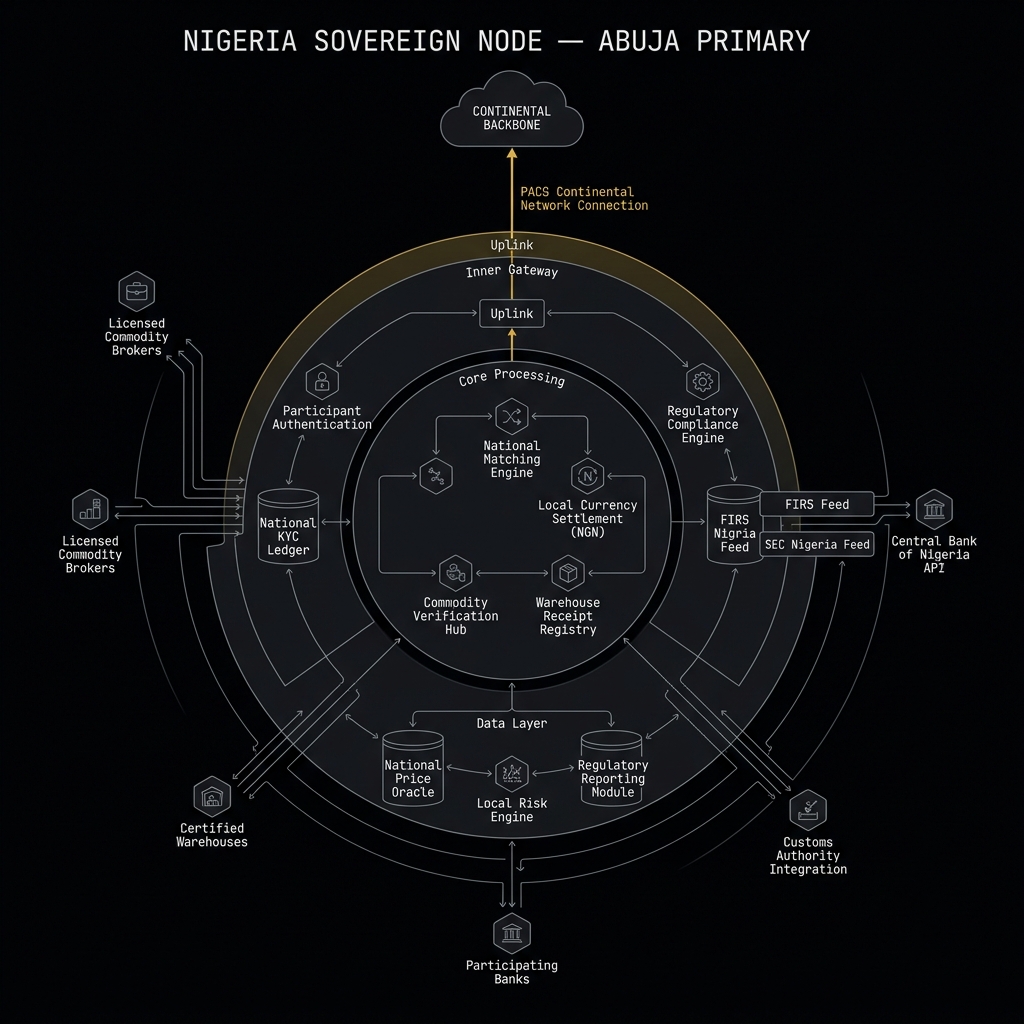
PACG national node architecture — Nigeria sovereign node Abuja primary
NATIONAL NODE ARCHITECTURE — NIGERIA SOVEREIGN NODE TEMPLATE: APPLICABLE TO ALL 54 MEMBER STATE NODES
NODE INFRASTRUCTURE
NATIONAL NODE COMPONENTS
  • Participant authentication gateway (OAuth 2.0 + PKI)
  • National KYC ledger — federated to continental registry
  • National matching engine — local order book management
  • Local currency settlement bridge (NGN/KES/ZAR etc.)
  • Commodity verification hub — DWR issuance engine
  • Warehouse receipt registry — national master ledger
  • Regulatory compliance engine — SEC/CBN/FIRS feeds
  • National price oracle — local exchange + commodity feeds
  • Regulatory reporting module — automated filings
  • PACG continental backbone uplink — fiber primary + satellite DR
UPTIME & RESILIENCE
NODE SLA SPECIFICATIONS
  • 99.99% uptime SLA — 52 min/year maximum downtime
  • Active-active data center configuration — minimum 2 DCs per node
  • Satellite backup link — Tier 1 nodes maintain independent VSAT
  • RTO: 4 minutes · RPO: 0 seconds (synchronous replication)
  • Continental failover: load transfers within 30 seconds
SECTION 03 — CROSS-BORDER SETTLEMENT ARCHITECTURE

Real-Time Sovereign Settlement System

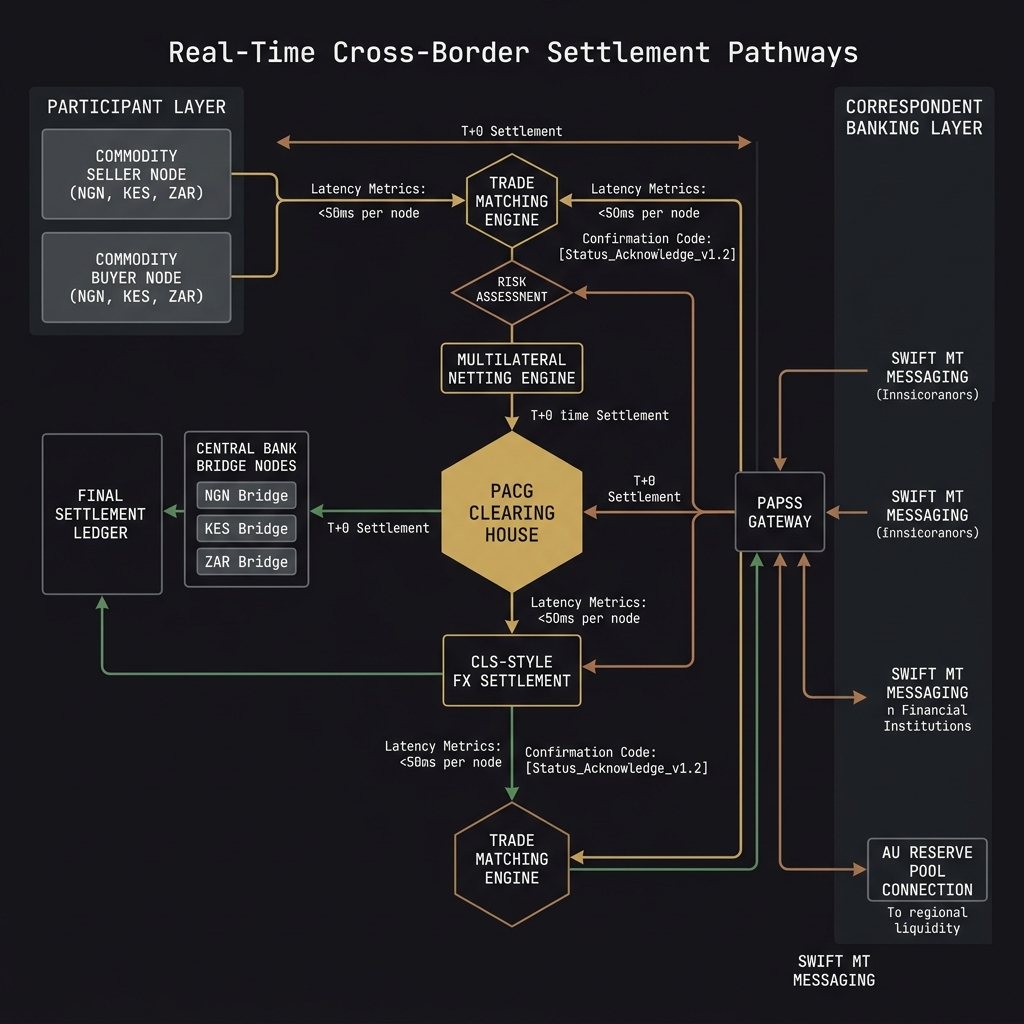
PACG operates the first T+0 continental commodity settlement network. All trades clear through the PACG Clearing House with multilateral netting, CLS-style FX settlement, and direct central bank bridge connections across 54 currencies.

PACG cross-border settlement architecture — real-time settlement pathway diagram
CROSS-BORDER SETTLEMENT ARCHITECTURE — T+0 REAL-TIME PATHWAY MODELED ON: CLS, CHIPS, SWIFT gpi · STANDARD: ISO 20022
SETTLEMENT PIPELINE
TRADE MATCHING ENGINE
  • Order received and time-stamped (nanosecond precision)
  • Counterparty identity verification — L1 compliance check
  • Risk pre-assessment — L5 AI scoring in <10ms
  • Price validation against PACG price oracle
  • Match confirmation to both counterparties
CLEARING PROCESS
PACG CLEARING HOUSE
  • Multilateral netting calculation — 5-second netting windows
  • Margin requirement verification and collateral lock
  • CCP central counterparty novation — PACG becomes buyer to seller
  • FX settlement routing — PAPSS gateway or bilateral bank bridge
  • Central bank bridge confirmation — direct RTGS instruction
FINAL SETTLEMENT
SETTLEMENT FINALITY
  • Final irrevocable settlement — central bank reserves transfer
  • DWR (Digital Warehouse Receipt) custody transfer confirmed
  • Settlement ledger entry — immutable record on PACG chain
  • Regulatory reporting — automated to national and AU authorities
  • Participant notifications — SWIFT MT / API push / portal alert
T+0
SETTLEMENT FINALITY
<50ms
END-TO-END LATENCY
54
CURRENCY BRIDGES
ISO 20022
MESSAGE STANDARD
SECTION 04 — AI INTELLIGENCE ARCHITECTURE

PACG Sovereign AI Engine

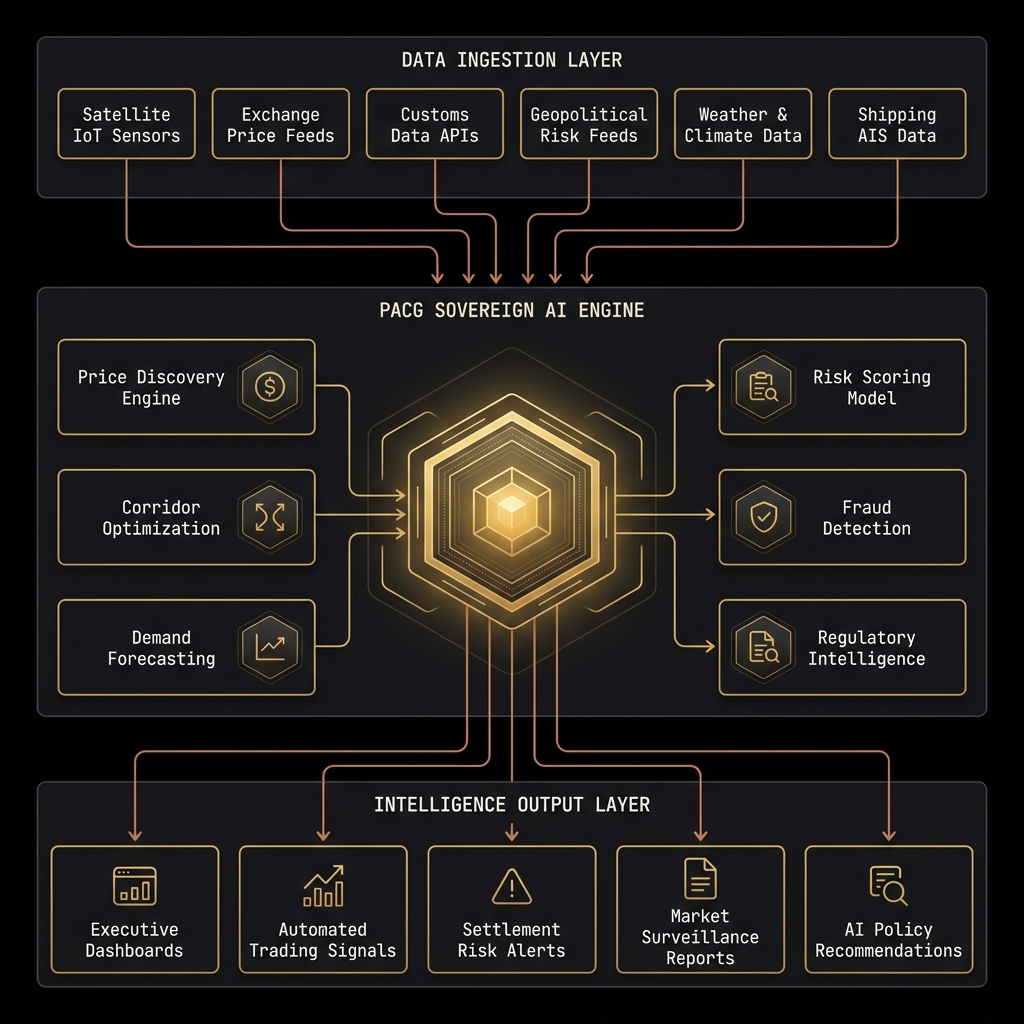
The PACG AI core processes 6 parallel data streams into 6 specialized intelligence outputs — driving automated price discovery, risk scoring, corridor optimization, fraud detection, demand forecasting, and regulatory intelligence in real time.

PACG AI intelligence architecture — sovereign AI engine with data ingestion and output layers
PACG SOVEREIGN AI ENGINE — INTELLIGENCE ARCHITECTURE TRAINING DATA: 10 YEARS CONTINENTAL TRADE · UPDATE CYCLE: REAL-TIME STREAMING
DATA INGESTION LAYER
6 SOVEREIGN DATA STREAMS
  • Satellite & IoT sensors — 847 warehouse locations, real-time
  • Exchange price feeds — LME, CBOT, ICE, AFEX, NCX, ECA
  • Customs data APIs — 54 customs authorities, pre-clearance data
  • Geopolitical risk feeds — Oxford Analytica, ACLED, UN OCHA
  • Weather & climate — satellite NDVI, rainfall, seasonal forecasts
  • Shipping AIS data — vessel tracking, port congestion metrics
INTELLIGENCE OUTPUTS
5 OPERATIONAL INTELLIGENCE PRODUCTS
  • Executive Dashboards — L6 Sovereign Command Center feeds
  • Automated Trading Signals — price anomaly and arbitrage alerts
  • Settlement Risk Alerts — counterparty default probability scores
  • Market Surveillance Reports — manipulation detection + regulatory
  • AI Policy Recommendations — trade policy optimization for AU Council
AI ENGINE SPECIFICATIONS
TECHNICAL ARCHITECTURE
  • Model type: Ensemble — transformer + LSTM + graph neural network
  • Training corpus: 10-year AfCFTA + COMESA + ECOWAS trade data
  • Inference latency: <5ms per risk score, <50ms per price oracle update
  • Retraining: Continuous online learning — no human-in-loop required
  • Explainability: SHAP-value rationale for all automated decisions
  • Sovereignty: All model weights hosted on continental cloud (AWS Africa Cape Town, Azure South Africa North)
AI GOVERNANCE
SOVEREIGN AI OVERSIGHT FRAMEWORK
  • AU AI Governance Board — quarterly model audit authority
  • Human override mandatory for decisions above $50M threshold
  • Bias detection: Automated monitoring for regional market distortion
  • Model versioning: Full auditability of all decision lineage
  • Aligned with: EU AI Act, AU AI Policy Framework 2024
SECTION 05 — SOVEREIGN GOVERNANCE ARCHITECTURE

Institutional Authority Structure

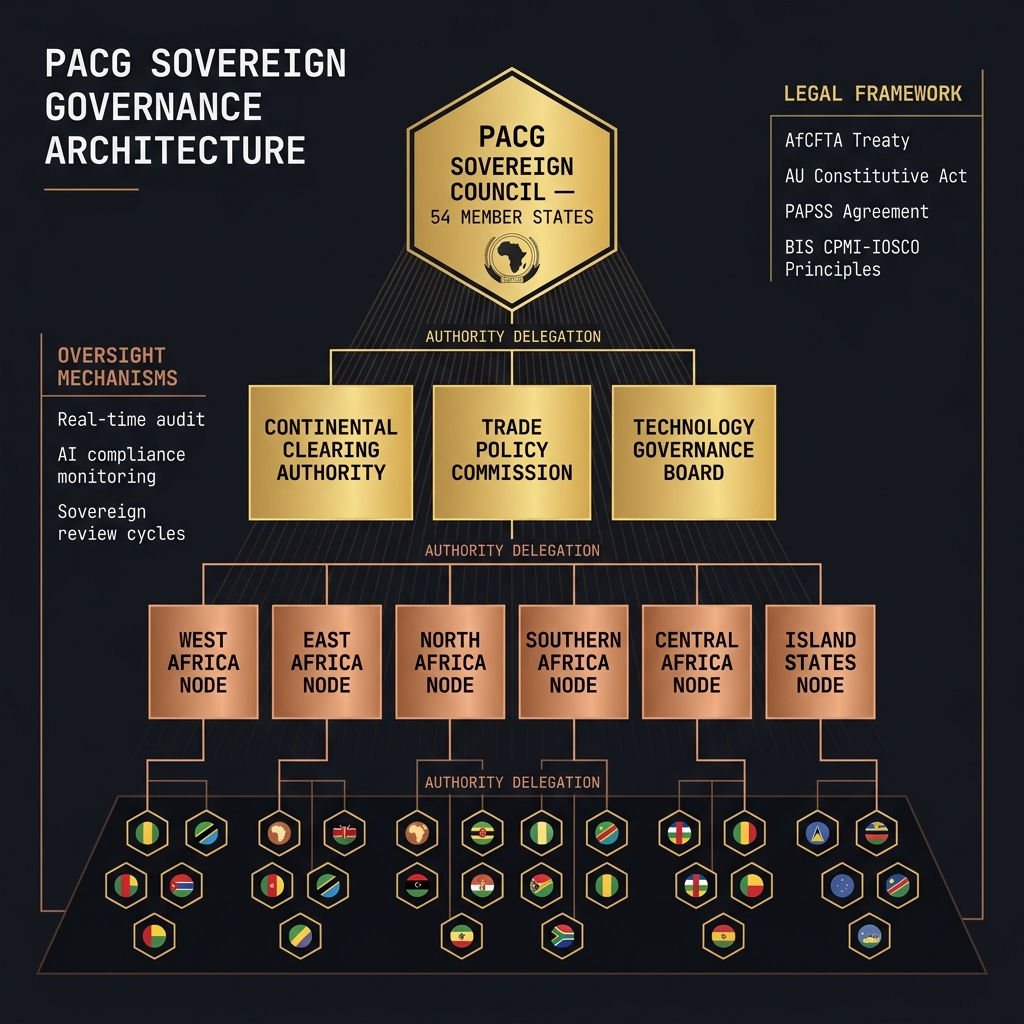
Four-tier governance pyramid: PACG Sovereign Council at apex, three specialist commissions at tier two, six regional node authorities at tier three, and 54 member state implementations at the base — all operating under AfCFTA and AU legal frameworks.

PACG sovereign governance architecture — four-tier institutional authority hierarchy
PACG SOVEREIGN GOVERNANCE ARCHITECTURE — 4-TIER AUTHORITY STRUCTURE LEGAL BASIS: AfCFTA TREATY · AU CONSTITUTIVE ACT · PAPSS AGREEMENT
TIER 1 — APEX
PACG SOVEREIGN COUNCIL
  • 54 member states — one vote per sovereign
  • AU Commission as permanent secretariat
  • Quarterly in-person council sessions
  • Emergency virtual council: 24-hour convening authority
  • Supranational regulatory authority over all 6 layers
TIER 2 — COMMISSIONS
THREE SPECIALIST BODIES
  • Continental Clearing Authority — financial oversight, CCP regulation
  • Trade Policy Commission — AfCFTA schedule administration
  • Technology Governance Board — system standards, AI ethics, cybersecurity
  • Each body: 9 rotating member state representatives
TIER 3 — REGIONAL
SIX REGIONAL NODE AUTHORITIES
  • West Africa Node Authority — ECOWAS alignment
  • East Africa Node Authority — EAC alignment
  • North Africa Node Authority — AMU alignment
  • Southern Africa Node Authority — SADC alignment
  • Central Africa Node Authority — ECCAS alignment
  • Island States Node Authority — IOC / COMESA alignment
SECTION 06 — INTEROPERABILITY FRAMEWORK

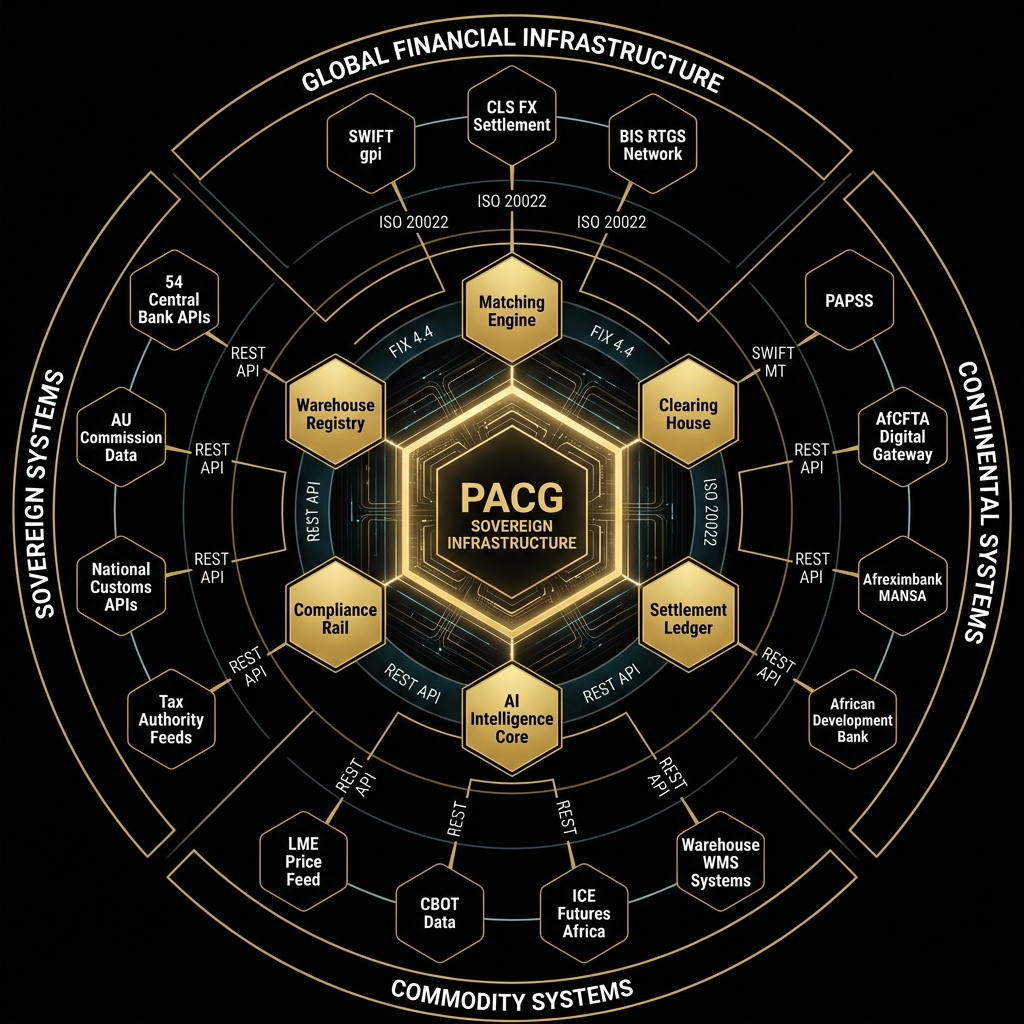
Global Systems Integration Map

PACG integrates with 18 external systems across four domains: global financial infrastructure, continental systems, commodity platforms, and 54 sovereign systems — all via standardized protocols (ISO 20022, FIX 4.4, REST API, SWIFT MT).

PACG interoperability framework — radial systems integration map showing all external connections
PACG INTEROPERABILITY FRAMEWORK — 18 EXTERNAL SYSTEM INTEGRATIONS PROTOCOLS: ISO 20022 · FIX 4.4 · REST API · SWIFT MT · GRAPHQL
INTEGRATION DOMAIN SYSTEM PROTOCOL DIRECTION SLA PURPOSE
GLOBAL FINANCIALSWIFT gpiSWIFT MT/MXBi-directional<30sCross-border correspondent banking confirmation
GLOBAL FINANCIALCLS FX SettlementISO 15022OutboundSame-dayG10 currency FX settlement for commodity contracts
GLOBAL FINANCIALBIS RTGS NetworkISO 20022Bi-directionalReal-timeCentral bank reserves movement confirmation
CONTINENTALPAPSSREST APIBi-directional<50msPan-African intra-continental payment clearing
CONTINENTALAfCFTA Digital GatewayREST APIBi-directional<1sTrade document validation and tariff schedule lookup
CONTINENTALAfreximbank MANSAREST APIInbound<5sKYC/AML verification for African corporate entities
CONTINENTALAfrican Development BankSOAP/XMLBi-directional<2sTrade finance facility access and guarantee activation
COMMODITYLME Price FeedFIX 4.4InboundReal-timeMetals benchmark pricing — copper, gold, platinum
COMMODITYCBOT / CME GroupFIX 4.4InboundReal-timeAgricultural commodity futures — cocoa, coffee, soybeans
COMMODITYICE Futures AfricaFIX 4.4Bi-directionalReal-timeAfrican-native futures contracts and derivatives
SOVEREIGN ×54Central Bank APIsREST/ISO 20022Bi-directionalReal-timeLocal currency settlement and reserve confirmation
SOVEREIGN ×54National Customs APIsREST APIBi-directional<2sPre-clearance, duty calculation, manifest submission
SECTION 07 — COMMODITY VERIFICATION ARCHITECTURE

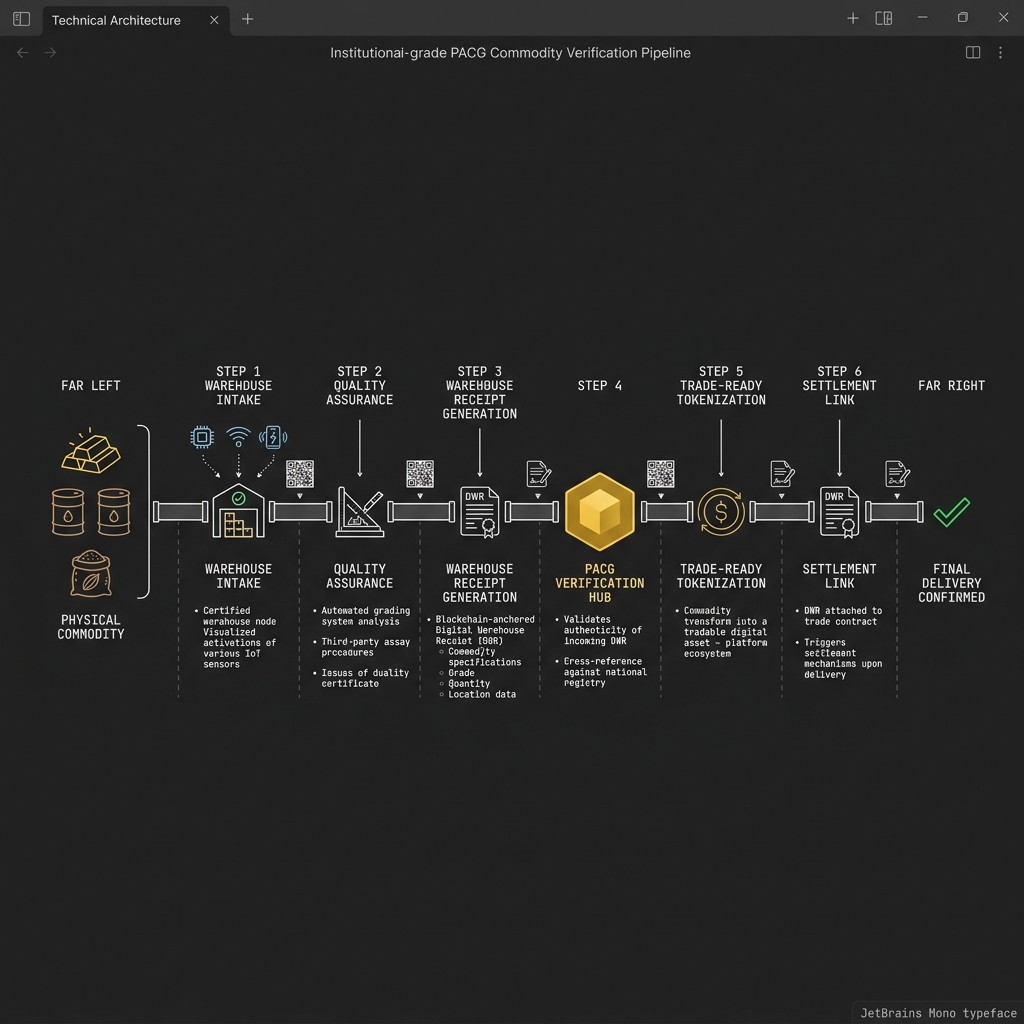
Physical-to-Digital Commodity Pipeline

The PACG commodity verification pipeline transforms physical commodities into sovereign-grade Digital Warehouse Receipts (DWRs) — the cornerstone of trust in the PACG trading system. Six steps, zero paper, full auditability.

PACG commodity verification pipeline — six-step physical to digital transformation
COMMODITY VERIFICATION PIPELINE — PHYSICAL → DIGITAL WAREHOUSE RECEIPT STANDARD: WRS ACT (NATIONAL) + PACG DWR PROTOCOL v2.1
STEP 1–2
INTAKE & QUALITY ASSURANCE
  • Certified warehouse operator receives physical commodity
  • IoT sensor activation: weight, temperature, humidity baseline
  • Tamper-evident seal application with PACG QR code
  • Automated grading system — optical + chemical analysis where applicable
  • Third-party independent assay for precious metals/minerals
  • Digital quality certificate issuance — immutable hash stored
STEP 3–4
DWR GENERATION & VERIFICATION
  • Blockchain-anchored DWR created with full commodity specification
  • Fields: commodity type, grade, quantity, location, expiry, custodian
  • National DWR registry entry — legal title transfer mechanism
  • PACG Verification Hub cross-references: national registry + IoT + assay
  • Three-point verification: document + physical + digital signature
  • DWR issued to authorized holder — cryptographically signed
STEP 5–6
TOKENIZATION & SETTLEMENT LINK
  • Trade-ready DWR becomes tradeable digital commodity asset on PACG
  • Fractionalization available: DWR split into minimum lot sizes
  • DWR attached to trade contract at order submission
  • Delivery confirmation triggers automatic payment release
  • Physical delivery instruction dispatched to warehouse operator
  • IoT confirms physical exit from warehouse — settlement finalized
SECTION 08 — TECHNICAL SPECIFICATIONS & STANDARDS

Infrastructure Engineering Standards

Full technical specification stack — from network protocols and data standards through security frameworks and hosting requirements. Every specification chosen to match or exceed SWIFT, BIS, and IOSCO infrastructure standards.

MESSAGING STANDARDS
DATA PROTOCOLS
  • ISO 20022 — all financial messages
  • FIX Protocol 4.4 — order matching
  • SWIFT MT/MX — correspondent messaging
  • JSON-LD — semantic trade documents
  • UN/CEFACT — trade data elements
  • HL7 FHIR-style — commodity schemas
SECURITY FRAMEWORK
CYBERSECURITY STANDARDS
  • NIST CSF 2.0 — primary framework
  • ISO 27001 — node certification required
  • SWIFT CSCF v2024 — financial messaging
  • TLS 1.3 minimum — all connections
  • HSM required — all key material
  • Zero-trust network architecture
HOSTING REQUIREMENTS
CLOUD & DATA SOVEREIGNTY
  • All data: African cloud regions only
  • AWS Cape Town + Azure Joburg primary
  • National nodes: domestic DC required
  • Data residency: sovereign law governed
  • No transatlantic data transfer for settlement
  • AU Commission: audit access to all logs
PERFORMANCE TARGETS
SYSTEM SLA METRICS
  • Settlement finality: T+0 (<5 seconds)
  • Order matching: <1ms per pair
  • API response (95th pct): <50ms
  • System uptime: 99.99% per year
  • Peak capacity: 500K trades/hour
  • Daily capacity: 2.4M settlements